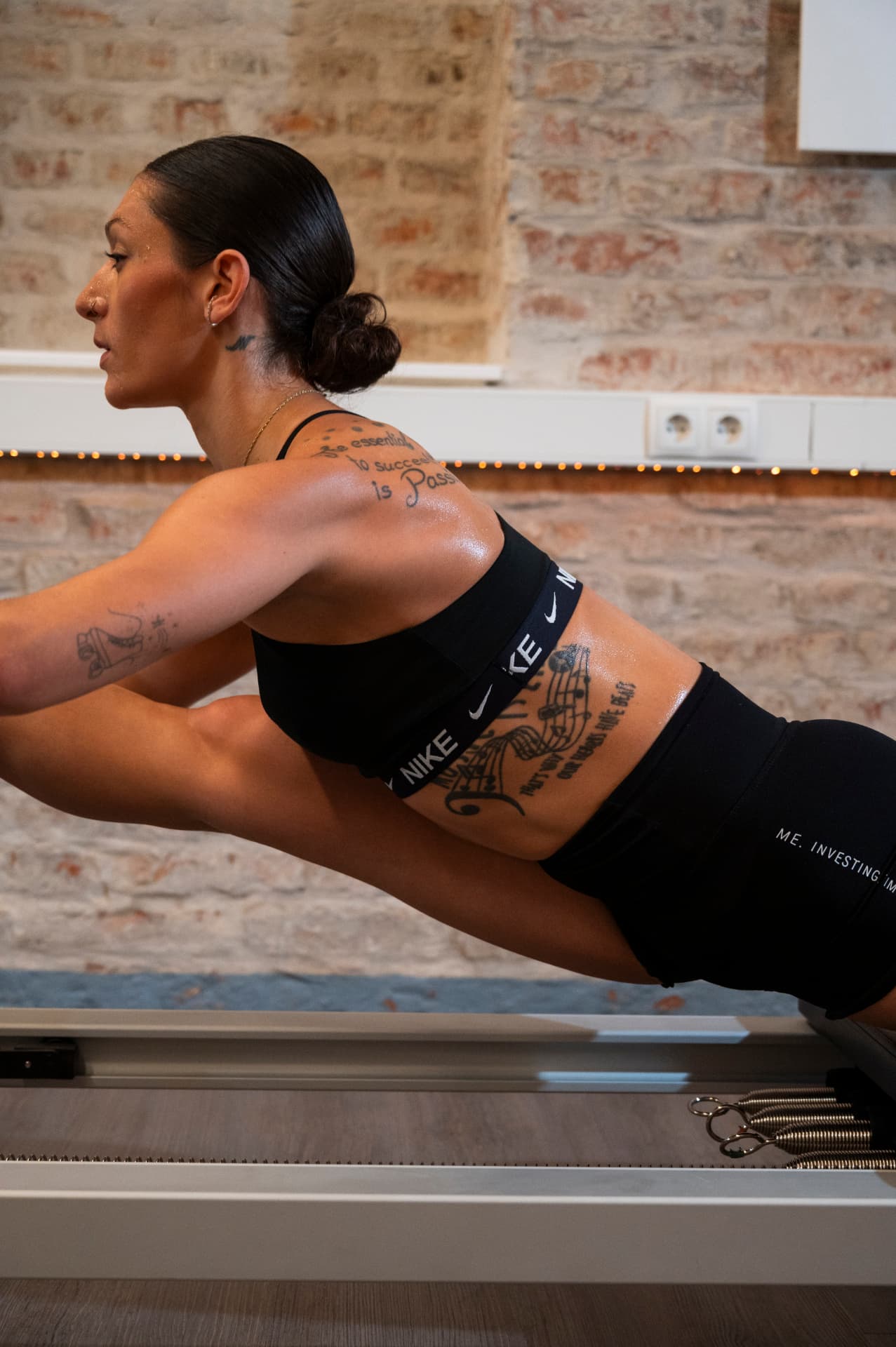
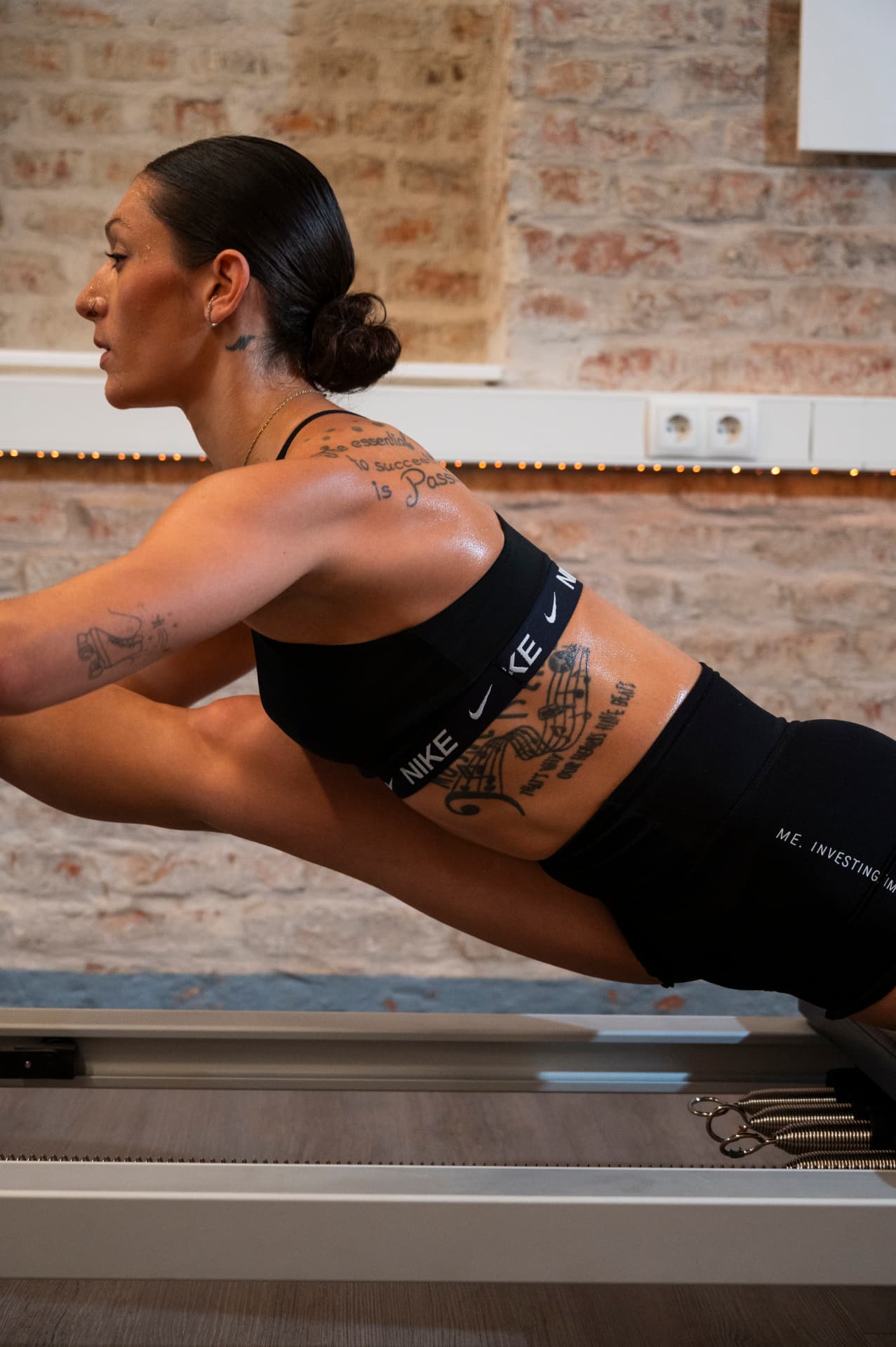
The front split has a reputation for being all about flexibility. In reality, it is a strength skill just as much as a stretch: your front leg works on active hip flexion while the back of the leg lengthens; your back leg needs a released front hip and strong glutes to extend behind you. Both legs do opposite jobs at the same time — and that is exactly what makes training for it so effective.
[ In short ]
- Front leg: strengthen the hip flexors and lengthen the hamstrings — activation in the front, length in the back.
- Back leg: release the hip flexors (iliopsoas, rectus femoris) and switch on the glutes — for stability and more reach behind you.
- Alignment is everything: hips square, level and still — no opening to the side, no arching through the lower back.
One position, two opposite jobs
The front leg and the back leg are doing completely different things at the same time. The front leg activates through the front of the leg — the hip flexors — while the back of the leg, the hamstring, lengthens. The back leg does the opposite: the front of the hip relaxes and lengthens while the back of the leg works — glutes and hamstrings activate to extend the leg.
That is also why I recommend exercises that combine strengthening and stretching of the hip flexors. A muscle is never just passively made longer — it needs strength and control in that new range. And because the quads are connected to the hip flexors and are big muscles, they need some release as well, especially for the back leg.
The key muscle groups for the front split
- Front leg — hamstrings: they need to lengthen. Active work — bending and straightening the leg — beats passive holding.
- Front leg — hip flexors: they need to strengthen. If they don't do their job, the quads jump in — and might start to cramp.
- Back leg — hip flexors: iliopsoas and rectus femoris need to release; they are the main brakes on hip extension.
- Glutes: they actively stabilise — especially on the back leg — and help it reach further back.
- Adductors and abductors: they keep side-to-side stability so the hips don't tip.
- Deep core: it keeps the pelvis neutral so you don't arch through the lower back to compensate.
Alignment: square hips, no cheating
The position of the hips is the most important detail in the front split. They should stay square: facing forward, not opening out to the side, and both hips on the same height — not one lifted higher than the other.
What usually happens? On the side of the back leg, we open the hips to sneak deeper into the split. It feels like progress, but it is an escape from the real work — and from the real stretch. The same goes for arching the lower back: it is another way of leaving the position while it still looks okay. Keep the torso upright and over the pelvis, and let the hips do the work.
My most important exercises
- Leg lifts — front and back, standing, on the knees or seated.
- Lunge variations — the classic front split preparation.
- Split slide outs — controlled slides into your end range.
- Forward folds — with bending and straightening of the leg, including flexing and pointing the foot.
- Turkey hamstring stretch and a deep quad stretch — my favourites for the front and back leg.
How to do them
Leg lifts: lift one leg at a time — bent first, then straightening it, or already straight. You can do them standing, on your knees or seated. Keep the core engaged, the lower back protected and the glutes working, and let the movement come from the hip. I like 10 on each leg to the front. For the back version, stand and fold forward, hands on the floor or something a little higher, back straight, hips square — and lift one leg at a time for 10. Pulses and holds are what I love to add: they challenge the end range and build the strength to stay there. If your quads start to cramp, bend the leg until you're ready to straighten it.
Slide outs: start on one knee (with straight legs once you're close to the split). Core engaged, hips square, lower back neutral — then slowly slide the front leg forward as far as you can without the hips opening to the side. 8 to 10 reps work well; hold some of them longer, or add a fixing point with your hands.
Lunge into half split: start in a low lunge with one knee down. Sit up tall and bring the chest away from the knee for the hip flexor of the back leg; bring the elbows down for a deeper stretch on the back of the front leg. Then push back into a half split: front leg straight, hips in line with the back knee, back straight — walk the hips up a little higher rather than rounding. Moving between the two is where the magic happens.
The most common mistakes
- Opening the hips to the side. This is the mistake I correct the most in my classes — it lets you escape the stretch while it feels like depth.
- Rounding the back. Touching your toes with a rounded back is not the same as folding with a straight back. A straight back in a challenging range is what actually gives you the release in the back of the leg.
My tips for your front split
Understand the position first: which muscles do you need to strengthen, and which ones do you need to release? Once you know that, consistency does the rest. It can honestly be the same five exercises that lead you to your goal — as long as you show up for them.
The sweet spot is strength combined with the nervous system: strengthening the hip flexors and glutes is what most people miss while they only think about stretching. For a lot of people, the real limits are strength, tight hamstrings or tight hip flexors. Later on, get creative — combine standing exercises and balance, and play with holding the split in different positions.
Train your front split at ARI
In our Learn the Splits classes we train exactly this: active flexibility, strength in the end range and alignment, with a coach who watches the details. Our Reformer Mobility and Mat Mobility classes build the foundation for it.
Learn the splits with us →FAQ
How do I get my front split?
Train strength and length together: strengthen the hip flexors and glutes, lengthen the hamstrings, release the front of the back hip — and keep the hips square. Consistent training with the same few exercises beats occasional intense sessions.
Which muscles are most important for the front split?
For the front leg: hamstrings (lengthen) and hip flexors (strengthen). For the back leg: hip flexors like iliopsoas and rectus femoris (release) and the glutes (strengthen). Adductors, abductors and the deep core keep you stable and your pelvis neutral.
What are the best exercises for the front split?
Leg lifts front and back, lunge variations, half splits, split slide outs, forward folds with bending and straightening of the leg, turkey hamstring stretches and deep quad stretches.
Where can I learn the front split in Vienna?
At ARI in Vienna (Lange Gasse 46, 1080) you can train your front split in our Learn the Splits classes, with Reformer Mobility and Mat Mobility building the foundation — always coached, 50 minutes per class.
A front split is not one stretch. It is strength, alignment and patience in one position. And every session counts.