Who doesn't know this sentence? My hips are so tight. Or my hips feel so stiff. Long hours of sitting shorten the hip flexors, switch off the glutes and leave the joint stiff. The instinct is to stretch more. Stretching alone rarely solves it. Why? Because a stiff hip is usually not just a short muscle. It is a joint that has lost strength and control in the ranges it barely uses anymore.
[ In short ]
- Tight hips usually come from too much sitting, too little varied movement and too little strength and stabilisation work for the hips — not (only) from a missing stretch.
- Passive stretching feels good and helps the flexibility of your muscles, but active mobility training creates lasting change in the hip joint: strength, control and a bigger range of motion.
- At ARI we train hip mobility on the reformer and on the mat: with and without resistance, always with control and coaching, 50 minutes at a time.
Why hips get stiff in the first place
Your hips are built to move in many directions: forward, back, out to the side, rotating in and out. Modern life uses almost none of that. We sit, we walk a little, we sit again.
Over time, the hip flexors stay in a shortened position for hours every day, the glutes barely work, and the nervous system starts treating deep ranges as unfamiliar territory. The result is that pulling sensation at the front or side of the hip (sometimes the inside), a lower back that takes over jobs the hips should do (and in the worst case starts to hurt as well), and knees that complain during squats and stairs.
Stretching vs. mobility
A classic hip flexor stretch lengthens the muscle. Pleasant, but not enough. Mobility training works differently: you move into a range and actively try to expand it. You hold, control and strengthen it.
That is the difference between borrowing a range and owning it. A hip you can control under load stays mobile and becomes more resilient for running, lifting and everything in between.
Another important factor is your mind: to protect you, it stops you from going too deep into a movement. But when you train strength and control, your body and mind learn that you can do this movement. And that you can do it safely.
What hip mobility training looks like at ARI
We train the hips the way we train everything: actively, with and without resistance, and with a coach who watches the details.
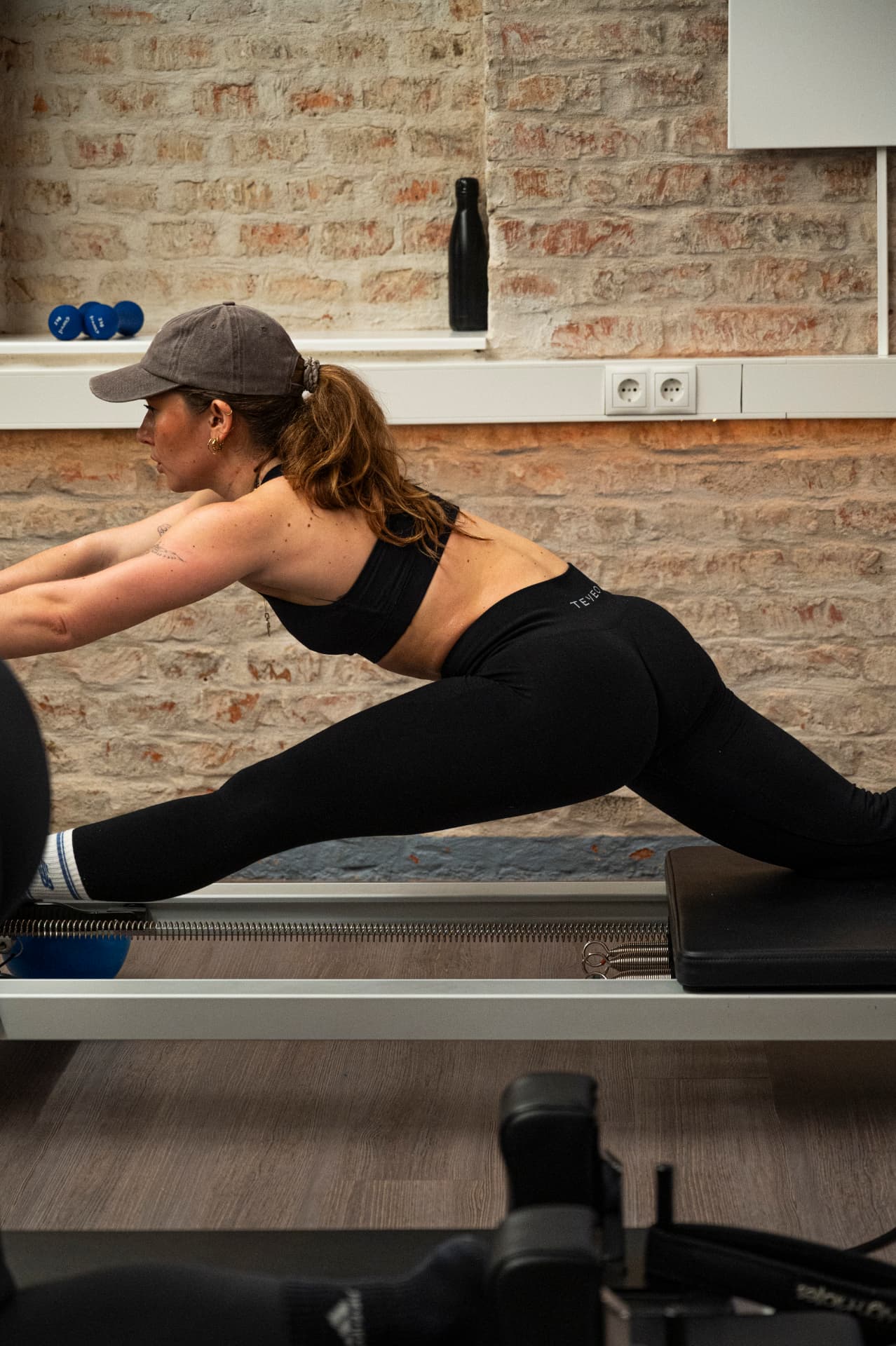
On the reformer, we use the springs both as support and as resistance — both can help us improve hip mobility. We work with deep lunges, rotations and lateral hip opener exercises, for example. The reformer gives you different feedback than the mat (or gravity). There is no better or worse here — just different.
On the mat, we build body control, partly working against gravity and partly simply super actively with the antagonists, the muscles opposite: active sumo squats for stronger external rotation, clam shells to strengthen the outer hips, or cossack squats for strength, control and external rotation in one (and yes, for the occasional Jesus Christ! or oh sht* in the room ;) )
- Active hip openers instead of long passive holds
- Strength in end ranges — the part that makes mobility last
- Glute and deep core work so the hips stop compensating
- Progressions for every level, from stiff beginner to athlete
Who this is for
Honestly? Almost everyone. Desk workers whose hips feel locked after the workday. Runners and lifters who notice their stride or squat depth shrinking. Dancers and yogis who want control in the ranges they already have. And complete beginners — you do not need to be flexible to start. That is what training is for.
Try Mat Mobility →How to start
If your hips are the main reason you want to train, start with Reformer Mobility or Mat Mobility. In both cases there are extra classes focused on the hips: Hip Mobility on the mat and Hips & Splits on the reformer. All full-body mobility classes naturally include the hips as well, training hip mobility and range of motion directly.
New to ARI? Our first-timer guide explains everything — from grip socks to what happens in your first class.
Read the first-timer guide →Mobile hips are not a talent. They are trained. And training them changes more than your squat.