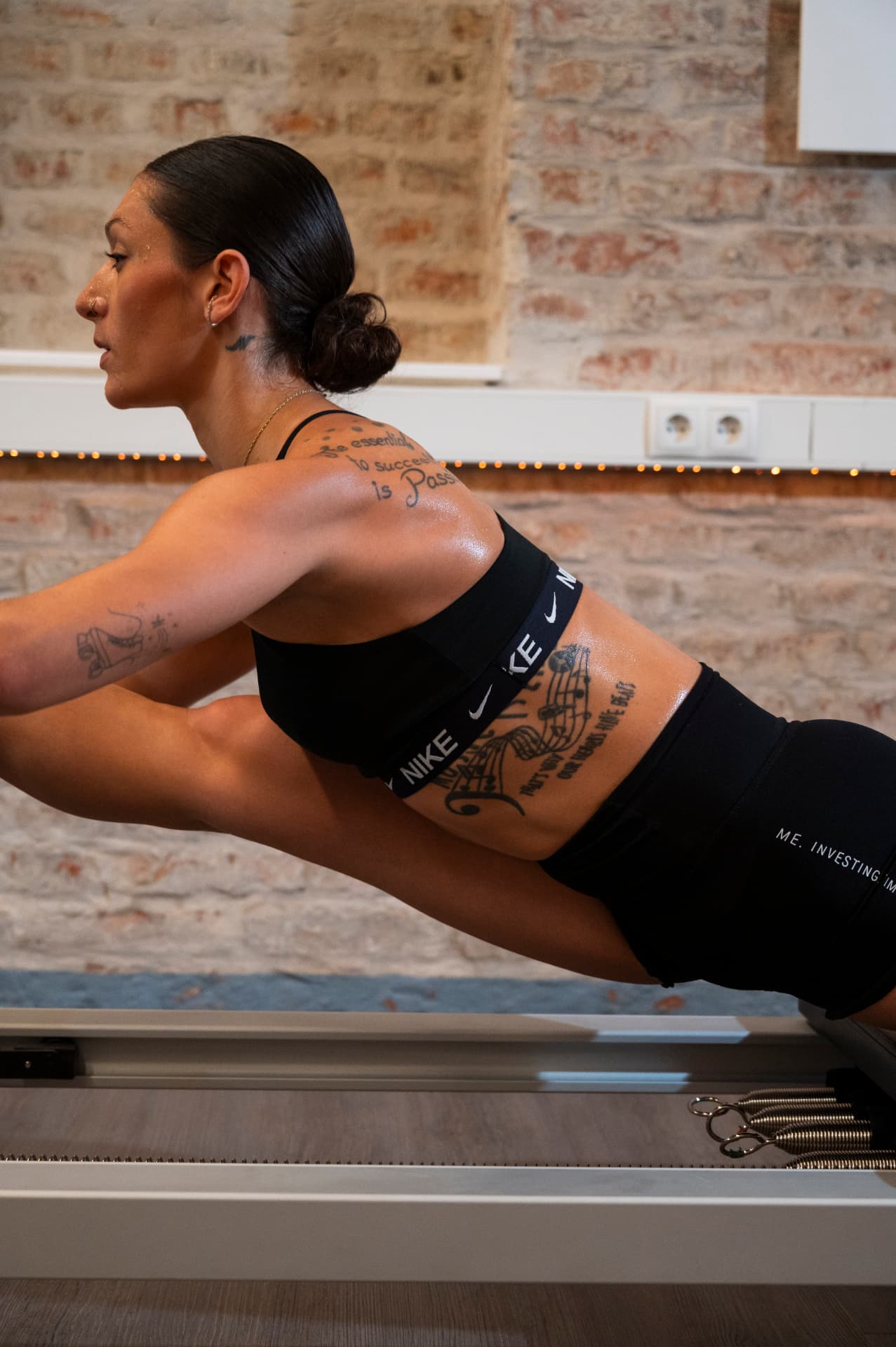
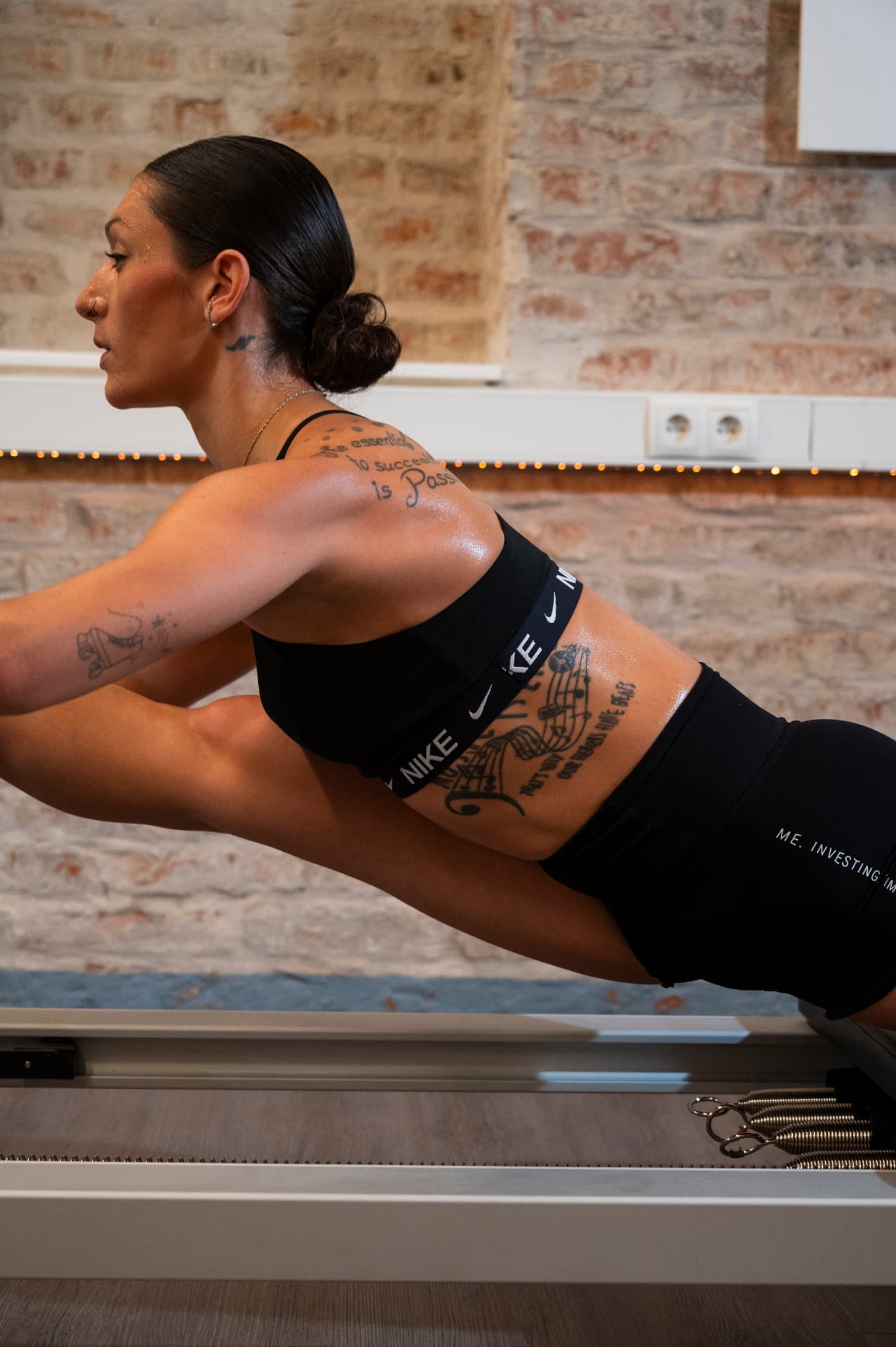
The middle split works through abduction and external rotation of the hip: the legs open to the side and turn out from the hip joint, while the pelvis tilts forward and the back stays straight. Like every split, it is strength and mobility together — not just sinking into the floor.
[ In short ]
- Focus: the adductors (inner thighs), the inner hamstrings and external rotation — mobility and strength in the hip joint itself.
- Technique: tilt the pelvis forward, keep the back straight and rotate the legs out from the hip — so there is no pressure on the knees.
- Anatomy matters: bone structure plays a bigger role than in the front split. Accept your individual limits and adjust angles to your body.
Middle split vs. front split: what's the difference?
- Movement: the front split works with hip flexion of the front leg and hip extension of the back leg. The middle split works with abduction and external rotation.
- Stretch: in the front split, the hamstring of the front leg and the hip flexors and quads of the back leg stretch. In the middle split it is mainly the adductors and inner hamstrings.
- Technique: the front split needs square hips and a neutral pelvis — no tilting, no arching. The middle split needs the pelvis tilted forward first, a straight back, and legs rotating out from the hip.
- Physical challenge: the front split asks for flexibility in the muscle chains at the front and back. The middle split asks for more mobility in the hip joint itself — and bone structure often plays a bigger role, which is why it can take longer and has individual limits.
The key muscle groups for the middle split
- Adductors — the inner thighs, the main stretch of the middle split.
- Inner hamstrings — especially when you tilt the pelvis forward.
- External rotators and the hip joint — mobility and strength in rotation.
- Glutes — stability in the hip and the strength to turn the legs out.
- Pelvic control — the anterior pelvic tilt that lets the hips open all the way.
The best exercises for the middle split
In general I do 8 to 10 reps of each and then hold the stretch for about 45 seconds.
- Butterfly and other external rotation exercises.
- Frog stretch — one leg straight and one bent, or both bent. Add a pelvic tilt, or push the hips back towards your heels.
- Straddle forward fold (pancake) — legs as wide as you can while seated, then fold forward. It combines abduction, pelvic tilt and rotation.
- Cossack squat — a side lunge with one leg straight and one bent, shifting through the middle from side to side.
- Wall straddle — lie on your back, glutes against the wall, legs straight up. First squeeze a block between your legs to work the inner thighs, then release and open the legs as wide as you can along the wall. The wall and floor assist your alignment.
- Split slide outs — once you're more advanced, slowly slide into the position with the right hip alignment.
Alignment: how to do them right
For any rotation, keep the back straight and let the movement really come from the hips — never put pressure on the knee.
Frog stretch: keep hips, knees and ankles aligned at 90 degrees. With one leg straight, rotate it out so the knee and toes face the ceiling. With both knees down, stay in that 90-degree alignment or slightly push the pelvis towards your heels.
Straddle: get the pelvic tilt first so you lengthen through the hamstrings and the lower back stays straight — don't just round forward. Don't let the knees drop in: engage the glutes and actively rotate the legs out.
Cossack squat: keep ankle and knee aligned, and the straight leg's knee and toes facing up. From there, sink the hips deeper. If the bent knee starts to drop in, come higher — engage the glute to keep it out and aligned with the ankle.
Engage the whole leg: switch on the quads, point or flex the toes and turn out from the hip — glutes engaged, knees and toes aligned.
The most common mistakes
- Missing the pelvic tilt and rounding the back — the most common issue. Without the tilt, you never really get into the right position or stretch the right spots safely.
- Uncontrolled knees, toes or leg rotation — they should rotate out and stay aligned, not drop in.
- Too much force — pushing and bouncing. Build strength, rotation and alignment first, then ease deeper.
- Skipping the warm-up — which can be really detrimental for the middle split.
- Ignoring a pinching feeling at the front of the hip. That can be a bone limit, not a stretching pain. Adjust the angle of your body instead of forcing it.
- Only stretching passively — you need strength and engagement to get deeper and to hold the split actively, not just against the floor.
How I correct it in class
Most of the time I adjust the straight back, which includes the pelvic tilt. I ask people to come a little higher to straighten out their back — and then, with the straight back, to slowly go deeper with their breath. Bending the knees slightly can also help to find the tilt.
This is very different from the front split: there you don't want to tilt the pelvis or arch the lower back. And while we focus on the adductors here, the hamstrings still play a huge role in the middle split as well.
My tips for your middle split
Train the pieces separately and together. Train the pelvic tilt deliberately — it is often a weak point, and targeting those muscles builds real strength.
Accept your individual anatomy and work with it in the best way you can. Your bones and muscles may be a little different — adjust movements, positions and exercises to your body instead of copying a routine everyone does.
Understand first which muscles you need and what they need to do — then start from there. And connect your mind to your body: it helps you target and engage exactly the right muscles.
Train your middle split at ARI
In our Learn the Splits classes we train active flexibility, strength in the end range and alignment — with a coach who watches the details. Reformer Mobility and Mat Mobility build the foundation. Working on the other split too? Read How do you get your front split?
Learn the splits with us →FAQ
How do I get my middle split?
Train abduction and external rotation with strength and mobility together: tilt the pelvis forward, keep the back straight, rotate the legs out from the hip and train consistently with exercises like frog stretch, pancake, Cossack squats and wall straddles.
What is the difference between the middle split and the front split?
The front split works with hip flexion and extension and needs square hips. The middle split works with abduction and external rotation, stretches mainly the adductors and inner hamstrings, and needs a forward pelvic tilt and more mobility in the hip joint itself.
What are the best exercises for the middle split?
Butterfly and other external rotation exercises, frog stretch, straddle forward fold (pancake), Cossack squats, wall straddles with a block, and later split slide outs. 8–10 reps, then hold about 45 seconds.
Why does the middle split take longer than the front split?
Bone structure plays a bigger role in the middle split, and it needs more mobility in the hip joint itself. That is why it often takes longer and why there are individual limits.
Where can I learn the middle split in Vienna?
At ARI in Vienna (Lange Gasse 46, 1080) you can train your splits in our Learn the Splits classes, with Reformer Mobility and Mat Mobility building the foundation — always coached, 50 minutes per class.
A middle split is not about forcing your hips open. It is alignment, strength and respect for your own anatomy. And every session counts.